Bike Gear Ratio Calculator
Type your chainrings and cassette, pick your wheel and tire, and see the ratio, gear inches, metres per pedal turn and speed for every gear.
Bike gear ratio calculator
| Gear | Ratio | Gear inches | Development | Gain ratio | Speed at 90 rpm |
|---|---|---|---|---|---|
| 50 x 11 | 4.55 | 121.3 | 9.68 m | 8.93 | 32.5 mph |
| 50 x 12 | 4.17 | 111.2 | 8.87 m | 8.19 | 29.8 mph |
| 50 x 13 | 3.85 | 102.7 | 8.19 m | 7.56 | 27.5 mph |
| 50 x 14 | 3.57 | 95.3 | 7.61 m | 7.02 | 25.5 mph |
| 50 x 15 | 3.33 | 89.0 | 7.10 m | 6.55 | 23.8 mph |
| 50 x 17 | 2.94 | 78.5 | 6.26 m | 5.78 | 21.0 mph |
| 50 x 19 | 2.63 | 70.2 | 5.61 m | 5.17 | 18.8 mph |
| 50 x 21 | 2.38 | 63.6 | 5.07 m | 4.68 | 17.0 mph |
| 50 x 24 | 2.08 | 55.6 | 4.44 m | 4.09 | 14.9 mph |
| 50 x 28 | 1.79 | 47.7 | 3.80 m | 3.51 | 12.8 mph |
| 34 x 11 | 3.09 | 82.5 | 6.58 m | 6.07 | 22.1 mph |
| 34 x 12 | 2.83 | 75.6 | 6.03 m | 5.57 | 20.2 mph |
| 34 x 13 | 2.62 | 69.8 | 5.57 m | 5.14 | 18.7 mph |
| 34 x 14 | 2.43 | 64.8 | 5.17 m | 4.77 | 17.4 mph |
| 34 x 15 | 2.27 | 60.5 | 4.83 m | 4.45 | 16.2 mph |
| 34 x 17 | 2.00 | 53.4 | 4.26 m | 3.93 | 14.3 mph |
| 34 x 19 | 1.79 | 47.8 | 3.81 m | 3.52 | 12.8 mph |
| 34 x 21 | 1.62 | 43.2 | 3.45 m | 3.18 | 11.6 mph |
| 34 x 24 | 1.42 | 37.8 | 3.02 m | 2.78 | 10.1 mph |
| 34 x 28 | 1.21 | 32.4 | 2.59 m | 2.39 | 8.7 mph |
Wheel size = rim bead seat diameter plus twice the tire width, the usual estimate. Real tires vary by a few mm.
Gear ranges of common bike setups
The lowest and highest gear of popular drivetrains, worked out with this calculator (road on 700 x 28c, gravel on 700 x 40c, mountain on 29 x 2.4).
| Setup | Lowest gear | Highest gear | Top gear at 90 rpm |
|---|---|---|---|
| Road standard 53/39, 11-28 | 37 in | 129 in | 34.4 mph |
| Road compact 50/34, 11-32 | 28 in | 121 in | 32.5 mph |
| Gravel 1x 40, 10-44 | 25 in | 111 in | 29.6 mph |
| Gravel 2x 46/30, 11-34 | 24 in | 116 in | 30.9 mph |
| Mountain 1x 32, 10-52 | 18 in | 94 in | 25.1 mph |
Lower gear inches make climbing easier; higher gear inches give more speed on flats and descents.
Bike wheel sizes used in the calculator
Wheel diameter is the rim bead seat diameter (the ISO number on the tire, like 622 for 700c) plus twice the tire width.
| Wheel and tire | Diameter | Diameter | Circumference |
|---|---|---|---|
| 700 x 23c | 668 mm | 26.3 in | 2099 mm |
| 700 x 25c | 672 mm | 26.5 in | 2111 mm |
| 700 x 28c | 678 mm | 26.7 in | 2130 mm |
| 700 x 32c | 686 mm | 27.0 in | 2155 mm |
| 700 x 40c (gravel) | 702 mm | 27.6 in | 2205 mm |
| 650b x 47 (gravel) | 678 mm | 26.7 in | 2130 mm |
| 29 x 2.4 (MTB) | 744 mm | 29.3 in | 2337 mm |
| 27.5 x 2.4 (MTB) | 706 mm | 27.8 in | 2218 mm |
| 26 x 2.1 (MTB) | 665 mm | 26.2 in | 2089 mm |
| 20 x 1.75 (BMX, folding) | 494 mm | 19.4 in | 1552 mm |
Bike gear formulas
Gear ratio
chainring teeth / cog teeth.
Gear inches
gear ratio x wheel diameter in inches.
Development (metres)
gear ratio x wheel circumference in metres.
Gain ratio
(wheel radius / crank length) x gear ratio, both in mm.
Speed
km/h = development in metres x cadence x 60 / 1000; mph = km/h / 1.609.
A road bike with a compact crankset
This AI sample shows a road bike with a double chainring and a wide cassette, the setup the calculator starts with. The second image is a color change made with our AI Bike Color Changer.
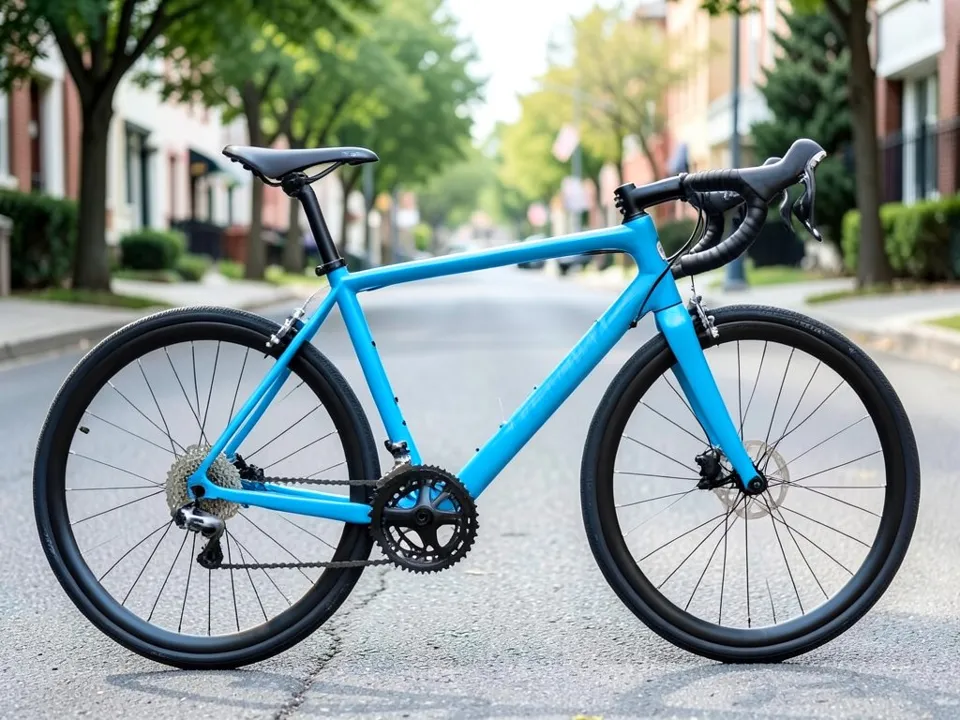

The example images are AI-generated samples made with our own image model, not photos of real customer vehicles, and they are not measured fitments.
Frequently asked questions
How do you calculate bike gear ratio?
Divide the chainring teeth by the rear cog teeth. A 50 tooth chainring with a 25 tooth cog is a 2.0 ratio: the rear wheel turns twice for each turn of the pedals.
What are gear inches?
Gear ratio times the wheel diameter in inches. It lets you compare gears across wheel sizes: a 50 x 25 gear on a 700 x 28c wheel (about 26.5 in) is about 53 gear inches. Below about 30 is a climbing gear; above about 100 is a fast descending gear.
What is development or rollout?
How far the bike moves for one full turn of the pedals, usually in metres. It is the gear ratio times the wheel circumference. Junior racing rules limit it, so racers use it to check their gearing.
What is gain ratio?
A measure from Sheldon Brown that also counts crank length: the distance the bike moves divided by the distance your foot moves in one pedal turn. It is the wheel radius divided by the crank length, times the gear ratio.
What gear ratio is best for climbing?
A low one: 1.0 or under (for example 34 x 34) on a road bike, and lower still on a loaded touring or mountain bike. Use the calculator to compare your lowest gear with the one you want and see what cassette gets you there.
Sources
Gain ratio and the ISO wheel sizes follow Sheldon Brown's references.
Picture your bike in a new color
Upload a photo and the AI Bike Color Changer repaints the frame in the color you pick.
Try a new color on your bikeThe calculators on this page are free to use. The AI visualizer needs a sign-in: most new accounts get 5 free credits (valid 30 days); a standard render uses 1 credit, and free renders carry a WheelAI watermark.
Also try: AI Bike Color Changer · Tire Size Calculator · Tire Size Comparison · Tire Size Chart · Tire Size Converter · How to Read Tire Size · Wheel Offset Calculator · Bolt Pattern Finder · Gear Ratio Calculator · Tire Speed Rating Chart · Tire Load Index Chart · Tire Date Code