Tire Pressure Light: Why It Is On and How to Fix It
Type your placard pressure, what the tire reads and tonight's low to see whether the light will come on. Then check what a solid or flashing light means.
Will the tire pressure light come on?
At 30°F the tire drops to about 31.2 psi (-3.8 psi).
The warning line is 26.3 psi, so the light should stay off, but the tire is still 3.8 psi under the placard. Add air.
US rules (FMVSS 138) make the light come on by the time a tire is 25% under the placard pressure. Many cars warn a little earlier. A flashing light that then stays on is a sensor fault, not a pressure reading.
Solid vs flashing tire pressure light
| What you see | What it means | What to do |
|---|---|---|
| Solid light after a cold night | One or more tires dropped below the warning line as they cooled | Check all four cold and fill to the placard |
| Solid light that came on while driving | A tire is losing air, possibly a puncture | Pull over safely and look for a flat or a nail |
| Flashes for about 60 to 90 seconds, then stays on | A fault in the monitoring system, not a pressure reading | Have the sensors checked; the system cannot warn you until it is fixed |
| On in the morning, off after driving | Tires are just under the line when cold | Add air when the tires are cold |
Why the tire pressure light comes on in cold weather
Air in a tire shrinks as it cools, so the pressure drops about 1 psi for every 10°F. A tire set to 35 psi on a 70°F afternoon reads less on a cold morning. US rules (FMVSS 138) require the light to come on by the time a tire is 25% under the placard pressure, which is 26.3 psi for a 35 psi placard.
| Temperature | Filled to 35 psi | Left at 30 psi | Light on at 30 psi? |
|---|---|---|---|
| 60°F | 34.1 psi | 29.2 psi | No |
| 50°F | 33.1 psi | 28.3 psi | No |
| 40°F | 32.2 psi | 27.5 psi | No |
| 30°F | 31.2 psi | 26.6 psi | No |
| 20°F | 30.3 psi | 25.8 psi | Yes, light on |
| 10°F | 29.4 psi | 24.9 psi | Yes, light on |
| 0°F | 28.4 psi | 24.1 psi | Yes, light on |
Worked out with the gas law on absolute pressure. A correctly filled tire stays above the 26.3 psi line; one left 5 psi low crosses it on a cold night.
How to fix a tire pressure light
- 1
Look at the tires
Pull over somewhere safe. If one is visibly flat, fit the spare or call for help instead of driving on it.
- 2
Find the right pressure
Read the placard on the driver door jamb. The number on the tire sidewall is the maximum, not the pressure to run.
- 3
Check all four with a gauge
The light does not say which tire is low on many cars, and two tires can be low at once.
- 4
Fill to the placard
Add air at a station or with a portable inflator, checking as you go.
- 5
Drive and watch the light
Most cars turn the light off after a few minutes of driving. If it comes back within a day, a tire is leaking; have it checked.
How to reset the tire pressure light
- Most cars reset on their own once every tire is at the placard pressure and you drive for a few minutes.
- Some cars have a TPMS reset button, often low on the dash or in the glovebox, or a reset step in the settings menu. The owner's manual shows which.
- After new tires, a tire rotation or new sensors, some cars need the sensors relearned with a scan tool. A tire shop can do this.
- A flashing light will not reset this way. It needs the faulty sensor fixed first.
New tires and the pressure light
Changing to a different tire, like the all-terrain tires in this AI sample, can change the pressure you should run. Light-truck (LT) tires often need more air than the passenger tires they replace to carry the same load, so ask the tire seller for the right pressure.
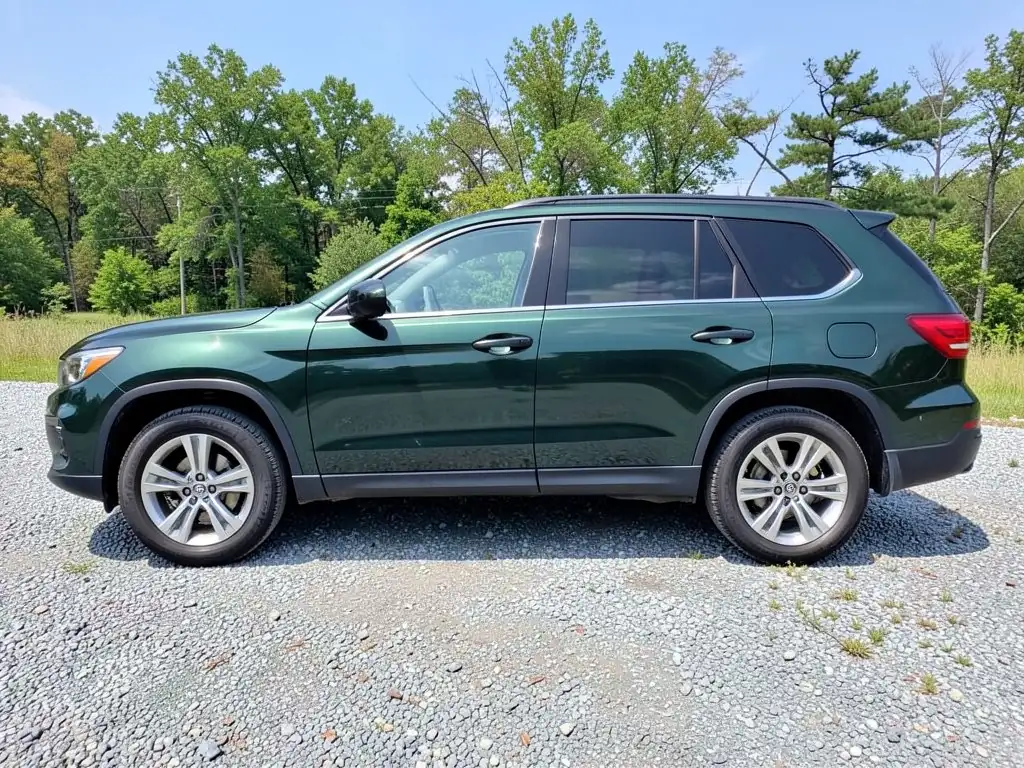
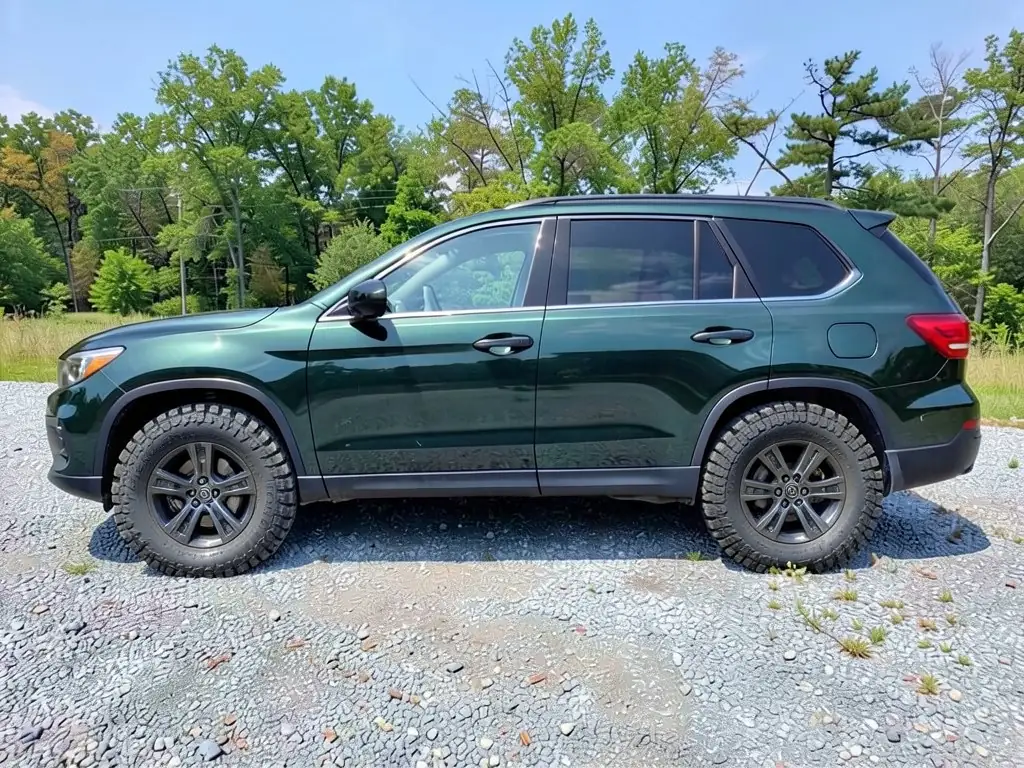
The example images are AI-generated samples made with our own image model, not photos of real customer vehicles, and they are not measured fitments.
Frequently asked questions
Why is my tire pressure light on when my tires look fine?
A tire can be 25% low and still look normal, especially a low-profile tire. Cold weather is the most common cause: tires lose about 1 psi for every 10°F drop. Check all four with a gauge before assuming the light is wrong.
What does a flashing tire pressure light mean?
If the light flashes for about a minute after you start the car and then stays on, the tire pressure monitoring system has a fault, such as a sensor with a dead battery, a sensor it cannot read, or wheels fitted without sensors. It cannot warn you about low pressure until that is fixed.
Is it safe to drive with the tire pressure light on?
Drive slowly to the nearest place where you can check and add air. A solid light means at least one tire is well below the right pressure, which hurts braking and handling and can overheat the tire. If a tire is visibly flat, do not drive on it.
How do I turn off the tire pressure light?
Fill every tire to the pressure on the driver door jamb placard, then drive. On most cars the light goes off by itself after a few minutes of driving. Some cars need a reset button or a menu step; your owner's manual shows where it is.
Why did the light come on in the morning and go off later?
The tires were just under the warning line when cold. Driving and the warmer afternoon raise the pressure a few psi, so the light goes off. The tires are still low, so add air when they are cold.
Sources
The warning line and the light behaviour come from the US tire pressure monitoring rule.
Thinking about new tires?
The Tire Visualizer shows all-terrain or mud-terrain tires on a photo of your own car or truck.
See new tires on your carThe calculators on this page are free to use. The AI visualizer needs a sign-in: most new accounts get 5 free credits (valid 30 days); a standard render uses 1 credit, and free renders carry a WheelAI watermark.
Also try: How to Check Tire Pressure · Tire Size Calculator · Tire Size Comparison · Tire Size Chart · Tire Size Converter · How to Read Tire Size · Wheel Offset Calculator · Bolt Pattern Finder · Gear Ratio Calculator · Tire Speed Rating Chart · Tire Load Index Chart · Tire Date Code